The teaching in Kanshoji

In Sôtô Zen, the teaching is transmitted from person to person.

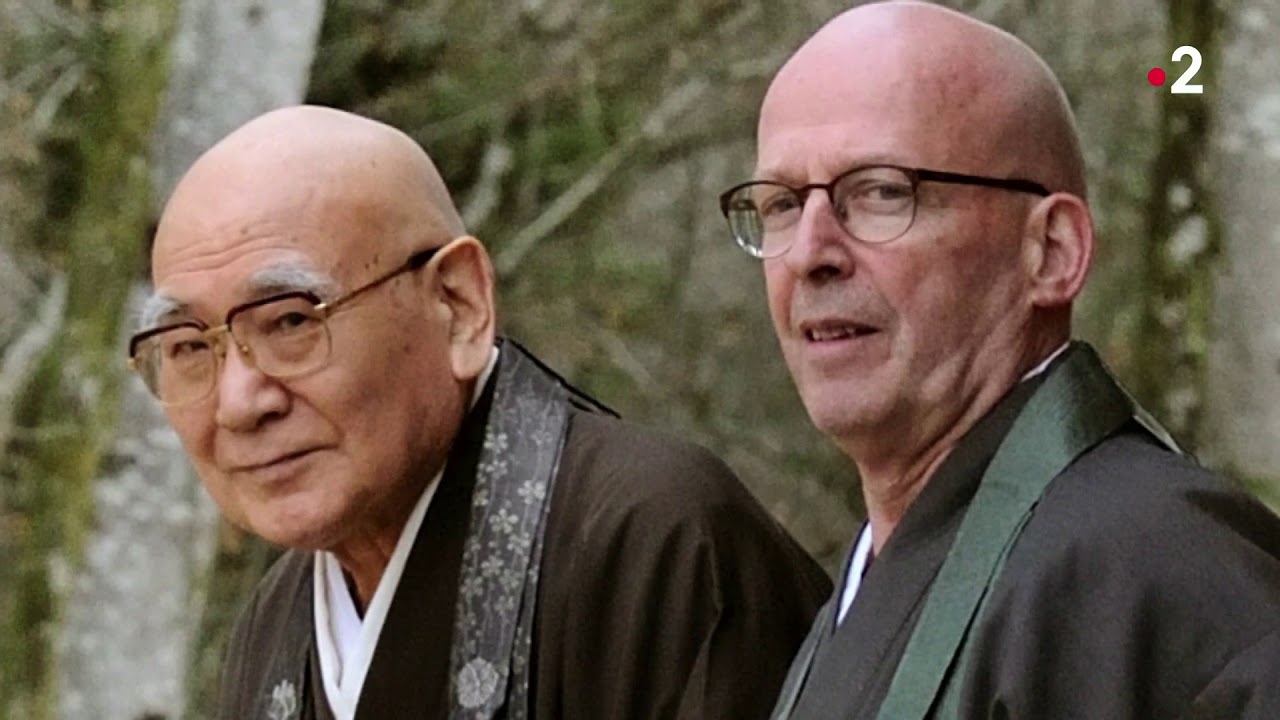
At Kanshoji, it is given by Taiun Jean-Pierre Faure, who received the Dharma transmission from Dônin Minamisawa Zenji, abbot of Eiheiji zen temple.

 Taiun Jean-Pierre Faure’s teaching is based on that of Shakyamuni Bouddha rewritten at each period. It takes the different traditional forms of sôtô zen (see page Sôtô zen buddhism). All the teachings are translated into English.

Kusen

Oral teaching given during zazen

Kusen is the oral teaching given by the teacher during zazen.

It is not literature. Sentences are simple, short and straightforward. The kusen speaks to the deep part of the brain, to the heart of the disciple, who should not try to grasp it intellectually.

Zazen 11 a.m.

The Buddha’s teaching asks us not to remain at the level of appearances, not to remain on the surface of things, in the foam of phenomena—that is, not to be carried away by rumours, by hearsay, by what we hear or read.

Shakyamuni Buddha said:

This truth that I have acquired is profound and difficult to understand; it is hidden, peaceful, subtle, accessible only to the wise. On the other hand, it is difficult for those who take refuge in objects of desire, difficult for those who are blinded by attraction and repulsion. Therefore, it is not words that enable human beings to understand. One must first become a true human being, freed from all illusions, in order to experience reality as it is.

He continues:  

I wondered if I feared the happiness of inconceivable freedom, so different from the happiness of satisfying countless desires. I saw that I had no fear of this happiness linked to inconceivable freedom.

You are sitting here in zazen. Your head is above your shoulders, your back is straight, your breathing is free, letting everything appear in your mind, letting everything disappear, thus tasting pure existence.

You are in the same position as that man, Shakyamuni Buddha. Are you interested in a happiness that depends on nothing, that is free from the satisfaction of desire, like the one we taste here and now?

Taiun JP Faure, February 2026

Unthinkable, inconceivable

Zen masters say: ‘What we must cherish above all else is the present moment.’ The past no longer exists. The future does not yet exist. The past ends in the present. The future begins in the present. This present moment is that of existence,…

Seeing oneself

Kōdō Sawaki wrote: "We must examine our motivations with our eyes wide open. Because even before we are aware of it, we perform for an audience, like a comedian anxious to please. If our practice is a kind of performance intended for an audience,…

What is Buddha? What is Reality?

Although reality cannot be captured in words, human beings constantly want to comment on it. Although Buddha's practice is at work in every corner of the Universe, it is difficult to talk about it. One thinker even said, quite rightly, that…

Chosan

Meeting with the abbot

The teacher expounds the Dharma freely in the presence of his disciples, around a cup of tea.
The teaching relates to real-life situations.

A monastery is not great because of its many disciples.
It is great because chosan is practiced daily.
Master Dôgen

Chôsan on engaged Buddhism

The premise of this chôsan is a film, The Venerable W, about a Burmese monk who encourages racism towards Islam. I have reservations about engaged Buddhism that shifts towards politics. That monk, pointing the finger at crimes committed…

Zen and psychoanalysis

" [...] Zen is different: its purpose is not to fix the ego, to make it compatible with society or the others. Zen deals with issues having to do with a whole other nature [...]"

Mondo

Questions and Answers

The mondo is the opportunity, for the disciple, to ask the teacher a question on some aspects of the teaching and how to realise them in daily life.

Teisho

Lectures

The commitment of a nun in the city (Hosetsu Laure Scemama – IZA seminar)

The commitment of a nun in the city (Hosetsu Laure Scemama) There exits several styles of life for a Zen monk or nun. I would like here to present an account of the style of life of a nun who is totally engaged in city life. In Japan,…

Personal experience: the monastic life (Yashô Valérie Guéneau – IZA seminar)

  As you can see, it is possible to live in a monastery for a number of years and remain quite normal! In our Sangha of the AZI certain members imagine that monks and nuns live in a monastery like “extra-terrestrial” beings – austere,…

Zen monk, bodhisattva : the-vows of the candidate for Awakening (Taiun JP Faure – IZA seminar 2014)

Human beings are religious animals. The Absolute is present at the heart of all phenomena of the universe. The entire universe practises the Way, naturally, unconsciously, and automatically. That gives rise to the question that Master Dogen…

Frequently Asked Questions

Ask questions

You are welcome to feed this page with questions. So, please feel free to send them to webmaster@kanshoji.org

There is no mind without a body, no body without a mind. They are two aspects of a single reality. When body and mind are unified, we can remain present to ultimate reality, like Buddha Shakyamuni says so well: “The sound that is heard and the one who hears it are instantly forgotten”
That is what we get into the habit of doing in zazen. In other words, regardless of the situation, we are totally open to it, totally available. When we let go of everything that appears on our consciousness, without running away from or rejecting anything, nothing separates us from reality. Body and mind in unity, we become one with all existences in the universe. Being in unity with all existences, we can respond to them with wisdom and compassion.

Zazen is not at the service of anything. Zazen is simply the manifestation of ultimate reality, which has no end per se. Bringing this ultimate dimension within us has the power to change our life… We realise then that our points of view, our conceptions, our interpretations are relative, and that in no case should they be confused with ultimate reality.

A wrong vision of reality leads us to believe that all things in life are permanent, solid; that they have their own existence, independent from the rest. But the opposite is true.
In reality, all things in life are impermanent: they exist in interdependence with all other things, and have no separate existence.

Buddha teaches that we are the cause of our suffering, which comes from our ignorance, greed and aversion. However, he also asserts that we can put an end to our suffering, if we free ourselves from those three defilements, the three poisons.
Ignorance (waywardness):
Not seeing the true nature of life, the true nature of all things, that is to say, Buddha nature. Ignorance stops us from leading our life the right way, harmoniously, because we do not see reality as it is.
Greed (envy):
Neglecting our true nature and that of all things, we do not have access to the satisfying feeling of peace and plenitude. Consequently, we are in a state of frustration and lack, which leads us to look for happiness in material possessions, social status, fame, recognition, etc.
Aversion (anger, violence, hatred…):
Oblivious to the state of awakening, we accuse others; we feel aversion for everything that bothers us; we feel anger and hatred towards the outside world.
It is because we follow the three poisons – often unknowingly – that we entertain relationships with the world which are not right, which prevents our fulfillment and that of others

To practice the Buddha way is to show wisdom and compassion. This can be realised when we become free of the three poisons — ignorance, greed and aversion — and of all the resulting toxic flows. Then, we are no longer locked up in our selfish thoughts, and consequently, no longer separate from other beings. We see the others as they are, with their joys and their sorrows. We feel the desire to help them with their sufferings. Being compassionate is being in unity with the others. The river of giving then flows naturally and freely between all existences. When we are free of the three poisons, the virtue of giving arises naturally. It’s a characteristic of Buddha’s functioning.

Poems

Sagesses Bouddhistes TV broadcast